 |
 |
|
| Convertabase's sole objective is to provide you with the most efficient bridge for moving your company's data. We understand that your information is the most vital mechanism of your business. By leveraging our suite of patent pending proprietary tools, we provide the fastest way to perform your database migration and integration with all the advantages of custom coding. |
|
| By using Convertabase's data migration and integration services, you eliminate the need to purchase expensive and training intensive third-party ETL vendor software, hire additional programmers or purchase more high performance hardware you'll also decrease the significant risks of cost and schedule overruns of 800% or more. |
|
| We strongly recommend that you copy your databases, files or any data storage mediums to a development environment and work there until the QA process is complete, this eliminates production slow downs from QA runs as well as work stoppages as you run your validation reports. |
|
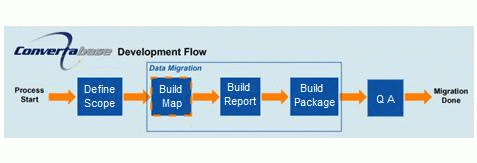
| We divide the entire data migration development into three major steps, with each step allowing you to better evaluate your ability to perform a successful data migration/integration using Convertabase services. |
 |
 |
The first step is to define the scope, what are we moving where, how often, by what protocol, how is the data stored now. Typically this process will take from one to two weeks depending on how much data there is, and how accessible the information is that we need to define the scope. Once this information is gathered you will be able to estimate the length of your project. |
|
|
The Second step is to build the migration, this in itself has three phases to it,
- Build the Map - Mapping the data should only be done once you are sure you know everything that will be moved.
- Build A Report - A report will determine if you are successful in your migration, summaries, totals, counts will all be in this report.
- Build the Package - Once you have the goal clearly defined, you build the package that gets you to the goal.
This second phase takes the bulk of most projects. |
|
|
The third and final phase is QA (quality Assurance). You should only begin to test the program that is going to use the data when the reports say everything is in the target. You should allocate one third of your total project time line for this QA process. |
|
| Once these three steps are completed, the data in the systems being synchronize will be accurate and changes made in a one database should show up correctly in the other database and both should be usable for production.. |
 |
|
| |

